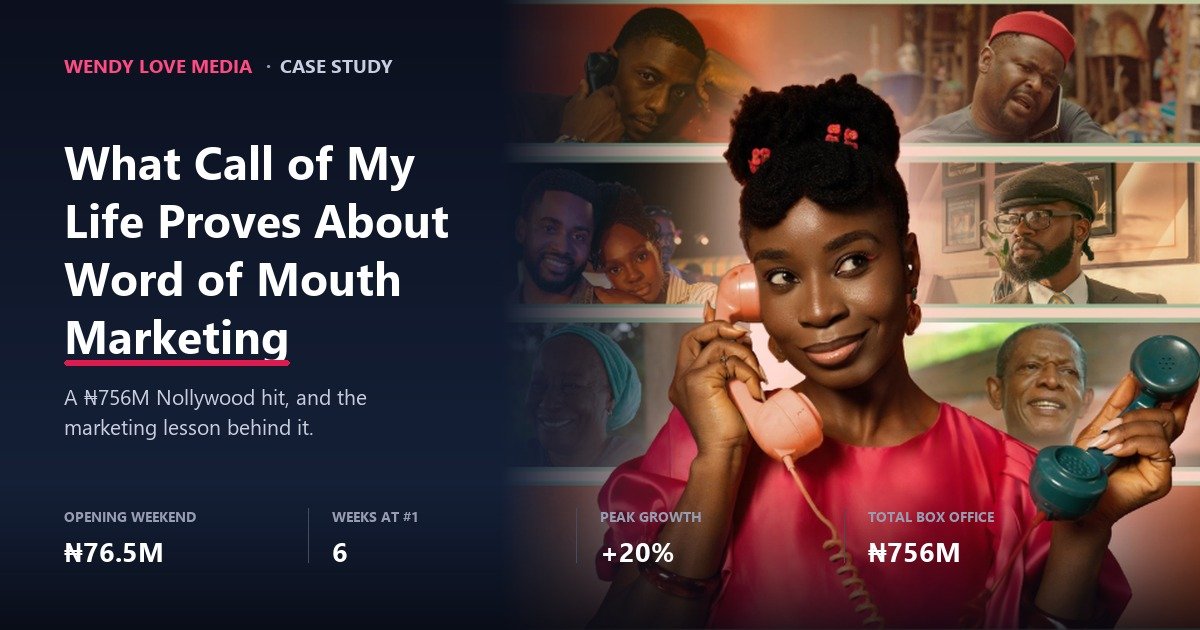
Call of My Life crossed ₦756 million at the West African box office this month. That makes it the number one Nollywood film of 2026, and one of the five highest grossing Nollywood releases ever made.
Here’s the part that should stop every marketer scrolling past this headline. The film didn’t get there with a huge ad budget. It didn’t lean on a stacked cast of A list names either. Dammy Twitch’s directing debut, produced by BluHouse Studios and distributed by FilmOne Entertainment, opened on May 15 with a modest ₦76.5 million weekend. Six weekends later, it was still the number one film in Nigerian cinemas. Four weeks in a row, ticket sales actually climbed instead of dropping off, at one point rising 20% weekend over weekend.
That pattern has a name. Word of mouth. Still the cheapest, most durable form of marketing on earth.
The product had to earn the recommendation first
Every article covering this film says some version of the same thing. Call of My Life succeeded “without an aggressive, multi city marketing budget or an ensemble cast of industry superstars,” as YNaija put it. The story, a romance about a woman named Soluchi healing from heartbreak who finds new love with a man named Eli after a chance phone call, is not a flashy premise. It’s a clean, well paced rom com that does the basics right.
That’s the uncomfortable truth about word of mouth marketing. It doesn’t start with a campaign. It starts with the product being good enough that a stranger feels compelled to tell another stranger about it. No amount of spend fakes that. You can buy attention. You cannot buy a recommendation.
Marketing still mattered, just not the way people assume
None of this means the team sat back and hoped. They ran a smart, cheap campaign that gave word of mouth something to attach to.
Director Dammy Twitch came into filmmaking from music videos and commercials, which meant the project launched with a built in digital audience most debut directors don’t have. The two leads played up their on screen chemistry in public, a classic rom com promotion trick that turns the audience into investigators trying to figure out if the spark is real. And when a music star connected to the film’s orbit became a trending topic for unrelated reasons, the team moved fast, organizing a meet and greet cinema event that produced what one outlet called “instant, organic video content that flooded TikTok and Instagram,” the kind of payoff a social media strategy is supposed to chase.
None of that costs much. All of it is fast, opportunistic, built to be shared rather than watched. That’s the actual playbook. Spend less. Give people more reasons to talk.
Why this matters beyond Nollywood
Every business chasing SEO growth is really chasing the same signal Google and AI search engines are chasing too, which is genuine audience trust. Search engines rank pages that people engage with, share, and return to. AI answer engines pull from sources that get cited and referenced across the web. Both of those outcomes trace back to the same root cause as a movie ticket line. Somebody experienced something worth telling somebody else about.
That’s the piece a lot of marketing plans skip. Teams will brief the content, target the keyword, build the backlinks, and never stop to ask if the underlying product or page actually deserves a recommendation. Call of My Life is a reminder that distribution amplifies what’s already true. It doesn’t create truth out of nothing. A weak product with heavy promotion gets one loud opening weekend and a quiet second one. A strong product with light promotion keeps climbing for six weeks straight, which is exactly what happened here.
Three takeaways for your own marketing
Fix the thing before you fund the campaign. If a landing page, a service, or a piece of content isn’t good enough to make someone forward it to a friend, more ad spend just gets more people to see the flaw faster.
Give word of mouth something to hold onto. The chemistry marketing, the trending moment turned into a meet and greet, the digital audience already built before launch, all of it gave people a reason to talk and a clip to share. Word of mouth rarely spreads on its own. It spreads when you hand people something specific and shareable.
Watch the second week, not the first. Anyone can buy an opening weekend. Call of My Life proves the real signal is whether ticket sales grow after the marketing push fades. The same logic applies to a product launch, a new service page, or a piece of content. If engagement holds or climbs after the initial push, you’ve built something people are recommending. If it drops the moment the ads stop, you’ve rented attention, not earned it.
Nigeria’s box office just handed marketers a ₦756 million case study for free. The lesson isn’t that marketing doesn’t matter. It’s that marketing works best when it has something true to amplify, and the truth has to come first.